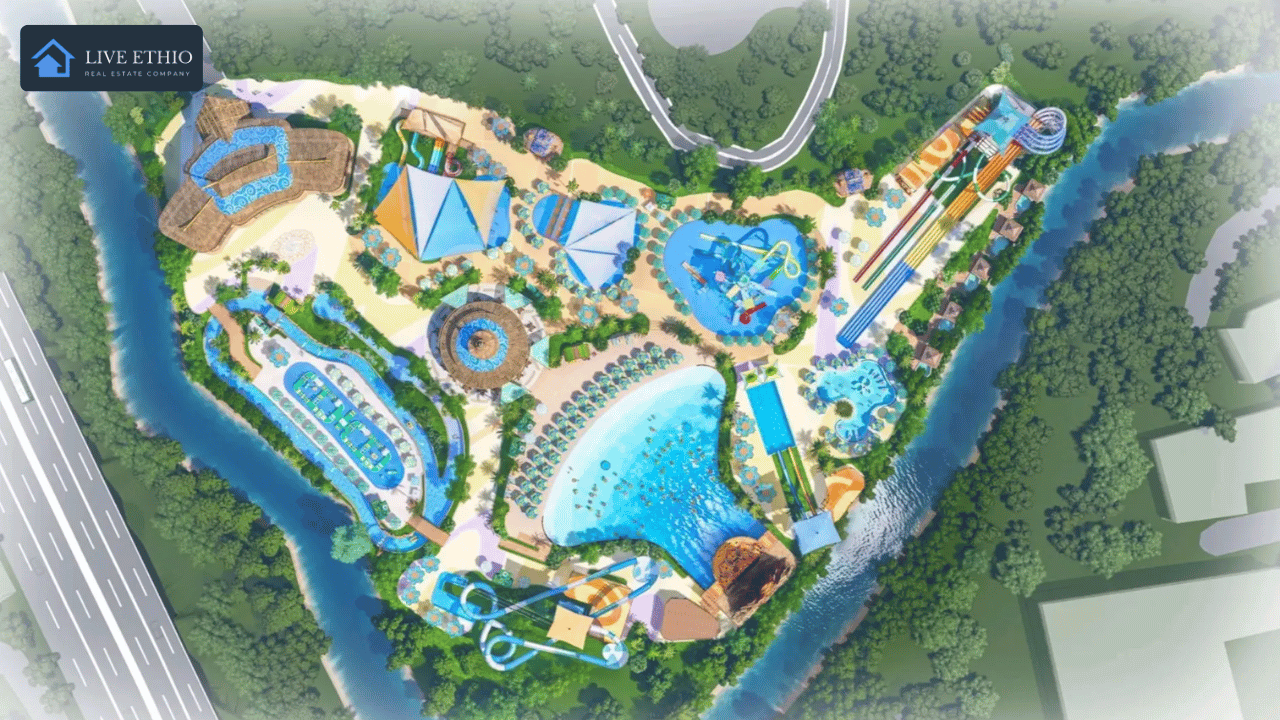
When Recreation Meets Real Estate
When evaluating a real estate investment, most people consider familiar factors such as location, road access, infrastructure, neighborhood safety, and proximity to schools or workplaces. However, another factor deserves attention: the recreational attractions that draw people to a particular area. A major water park, amusement park, golf course, or public recreation center can do more than provide entertainment. Depending on its scale and popularity, it may attract visitors, create employment, encourage commercial development, and influence where people choose to live or invest. This raises an interesting question for Ethiopia's real estate market. With a new Kuriftu Water Park being developed in Addis Ababa, could the surrounding area become more attractive to property buyers, tenants, and businesses? Could investors who recognize the potential early benefit from future changes in property values? International research offers some useful insights into the relationship between recreational facilities and real estate prices. However, the outcome in Addis Ababa will depend on the project's location, accessibility, commercial success, and the development of its surrounding neighborhood. To understand the potential opportunity, it is worth examining how the relationship between recreation and real estate developed, what research tells us, and how these findings might apply to Addis Ababa.
1. The Historical Relationship Between Recreation and Real Estate
The relationship between recreational spaces and property values is not a new concept. For decades, urban planners, economists, and real estate researchers have examined how parks, open spaces, waterfronts, and other amenities influence residential preferences and housing prices. Historically, public parks and landscaped open spaces were incorporated into urban development partly to improve residents' quality of life. Over time, researchers began investigating whether these benefits were reflected in the prices people were willing to pay for nearby homes. One important approach is known as hedonic pricing. Rather than treating a property as a single product, this method examines how different characteristics contribute to its market price. These characteristics may include floor area, number of bedrooms, neighborhood conditions, transport access, environmental quality, and proximity to recreational amenities. The reasoning is straightforward: if two otherwise comparable properties differ in an important amenity, researchers can investigate whether that difference is associated with a difference in their sale prices. Research into parks and open spaces has repeatedly found evidence that recreational and environmental amenities can be reflected in property values. A 2001 review by economist John L. Crompton examined empirical research on the impact of parks on property values. A subsequent review by Crompton and Sarah Nicholls, published in the Journal of Leisure Research in 2020, examined 33 studies conducted in the United States. The authors generally found that residential values tended to be higher closer to parks, although the size of the effect varied by location and type of recreational space.
Read the research: Impact on Property Values of Distance to Parks and Open Spaces.
These findings helped establish recreational amenities as a legitimate consideration in real estate valuation. However, they do not mean every recreational attraction increases the value of every nearby property. A peaceful public park offers a different experience from a commercial amusement park that attracts thousands of visitors, generates traffic, and operates late into the evening. The distinction matters when examining the potential influence of a water park in Addis Ababa.
2. Why Recreational Attractions Can Influence Property Prices
To understand how a new recreational destination might affect property values, it helps to consider the economic activity it could generate.
Increased demand for nearby accommodation
A popular attraction can draw visitors from other cities and, in some cases, international tourists. Some visitors may prefer to stay close to the attraction rather than travel long distances each day. This could create opportunities for hotels, serviced apartments, guesthouses, and other accommodation businesses, depending on visitor demand and local regulations. For residential landlords, the effect may be less direct. Employees working at the attraction or at nearby restaurants and shops could become potential tenants. Families who value convenient access to leisure facilities might also consider living in the surrounding area. However, these outcomes depend on the number and type of visitors, their accommodation preferences, and the availability of suitable alternatives.
Growth in surrounding businesses
Recreational destinations can create demand for supporting services, including restaurants, cafés, convenience stores, transportation providers, and retail businesses. If a water park attracts consistent visitor traffic, some of this spending may flow into the surrounding neighborhood. Business activity can, in turn, make an area more commercially active and potentially more attractive to property investors. For example, a commercial property near a successful entertainment destination might benefit from increased customer traffic. A residential property could benefit indirectly if improved amenities and services make the neighborhood more desirable. The important consideration is whether the attraction generates activity beyond its own boundaries. A destination where visitors spend their entire day and all their money inside the complex may have a different effect on surrounding businesses from one that encourages visitors to explore the wider neighborhood.
Improvements in infrastructure and accessibility
Large recreational developments sometimes form part of broader urban development projects. These may include upgraded roads, parking facilities, public spaces, transport connections, landscaping, and commercial infrastructure. Such improvements can influence property demand independently of the attraction itself. For example, if an area becomes easier to reach and gains better public amenities, it may attract more residents and businesses. In this situation, the water park could be one part of a wider transformation rather than the sole reason for rising property values. Investors should therefore examine the entire development surrounding an attraction, not simply the attraction in isolation.
Changes in neighborhood perception
A recognizable destination can also influence how people perceive an area. Locations previously viewed mainly as residential outskirts or undeveloped land may gain greater visibility once a major attraction opens. This could encourage developers to introduce new residential, hospitality, or commercial projects.Nevertheless, increased visibility does not guarantee higher property prices. Buyers still consider affordability, infrastructure, construction quality, security, access to essential services, and the overall economic outlook.
3. What International Research Says About Property Near Recreational Spaces
Research provides evidence that recreational amenities can influence property prices, but the size and direction of the effect depend on the type of facility and its surroundings. A study published in Landscape and Urban Planning examined the relationship between regional parks and nearby property values. It found that homes within half a mile of the parks had values approximately 6–9% higher on average than homes farther away in the study area. The researchers also found that the estimated premium was greatest at approximately one-third of a mile, rather than immediately beside the parks.
The authors discussed several possible explanations, including access to recreation, environmental benefits, and the possibility that properties closest to heavily used parks experience unwanted noise.
Read the study: Integrating Property Value and Local Recreation Models to Value Ecosystem Services from Regional Parks.
These findings illustrate an important principle: proximity can be valuable, but the relationship is not necessarily linear. A home within convenient walking distance of a recreational facility may offer residents easy access to leisure activities. A property directly beside a busy entrance, however, may experience traffic congestion, noise, parking pressure, or reduced privacy. There is also a limitation when applying this research to water parks. Public parks and open spaces are not identical to commercial entertainment complexes. The findings provide a useful starting point for understanding the relationship between amenities and property values, but they cannot establish how much property prices in Addis Ababa will change because of a new water park. The relevant question is not whether recreational facilities can influence property values in general. It is whether this particular development will create sufficient demand and improve the surrounding area's attractiveness enough to affect the local property market.
4. Introducing Addis Ababa's New Kuriftu Water Park
Ethiopia already has experience with water-based recreational development. Kuriftu opened its water park in Bishoftu in August 2019, establishing a major leisure attraction outside Addis Ababa. Reporting on its inauguration described a wider development that included recreational facilities and retail space. You can read more about the original development in this report on the opening of Ethiopia's first water park. Kuriftu is now also associated with a new water park project in Addis Ababa. In 2025, public posts shared construction imagery and described the proposed attraction as a major addition to the city's entertainment and tourism offering. This is relevant because a major leisure destination within the capital could serve a different market from a resort-style attraction outside the city. Its potential customer base could include Addis Ababa residents seeking family entertainment, visitors from other parts of Ethiopia, and tourists whose itineraries include the capital. However, the project's precise location, construction milestones, opening date, and final facilities should be confirmed using current information from the developer or relevant authorities before publication. The existence of construction activity alone does not establish when the attraction will open or how successful it will become. For real estate investors, the most interesting question is what the development could mean for the area around it. If the water park attracts consistent visitors, creates employment, and encourages other businesses to establish themselves nearby, it could contribute to increased demand for particular types of property. If it forms part of a larger mixed-use or recreational development, the combined effect of the surrounding facilities may be more significant than the water park alone. These are plausible investment scenarios, not yet proof of an increase in local property prices.
5. Could the New Water Park Increase Property Prices in Addis Ababa?
The short answer is that it could, but the extent of any effect remains uncertain. There are several possible ways the water park could influence the surrounding property market.
Residential properties
If the attraction becomes a popular destination and the surrounding area benefits from better infrastructure, some residential properties may become more appealing to buyers and tenants. The strongest demand may come from households that value access to leisure facilities, workers employed by the attraction and nearby businesses, or residents who benefit from broader neighborhood improvements. However, an increase in visitors does not automatically translate into an increase in residential demand. Some people may prefer to visit the attraction occasionally without wanting to live nearby.
Rental properties and hospitality
The water park could create opportunities for short-term accommodation if it attracts enough visitors who need somewhere to stay. Nearby hotels, serviced apartments, and furnished rentals might benefit from this demand. Yet the potential depends on the nature of the attraction. If most visitors are Addis Ababa residents making day trips, the impact on overnight accommodation could be limited. If the park becomes part of a broader tourism itinerary, the opportunity could be different. Investors should assess visitor origin, expected length of stay, competing accommodation, operating costs, and applicable rental rules before assuming that a short-term rental business will be profitable.
Commercial real estate
Restaurants, cafés, retail outlets, convenience stores, and service businesses may benefit from increased visitor activity. For commercial property owners, the key question is whether enough people will move through the surrounding area to support these businesses. Access roads, visibility, parking, pedestrian movement, and the location of the park's entrances could all influence the opportunity. A commercial property close to a busy entrance might have a different outlook from one located nearby but separated from visitor routes by difficult access or competing developments.
Land and development opportunities
Landowners and developers may also watch the area for signs of new residential or commercial development. If infrastructure improves and demand grows, the area could become more attractive for future projects. However, land prices can rise in anticipation of a development before its economic benefits materialize. This creates an important distinction between buying at a price supported by current market conditions and paying a premium based on expectations about future growth. The more investors pay upfront for anticipated appreciation, the less room there may be for a satisfactory return if the project develops more slowly than expected.
6. Could Investors Benefit by Buying Before the Water Park Opens?
One of the most interesting aspects of this development is the possibility of identifying investment opportunities before the attraction becomes fully operational. In real estate, infrastructure and development announcements can influence expectations long before a project opens. Some buyers may anticipate that a new attraction will draw visitors, create jobs, or encourage additional development. If these expectations eventually translate into real demand, investors who purchase suitable properties at reasonable prices may benefit from future appreciation or rental opportunities.
But buying early is not automatically a winning strategy.
There are several risks to consider.
First, the anticipated benefit may already be reflected in the asking price. If landowners and sellers have increased their prices in response to construction news, an investor may already be paying for some of the expected future growth.
Second, the project may take longer than expected to become operational. Delays can postpone any potential economic benefit, while the investor continues to bear holding costs and other expenses.
Third, the attraction may not generate enough demand to transform the surrounding neighborhood. Visitor numbers, spending patterns, accessibility, and the presence of supporting businesses will all matter.
Fourth, the surrounding area may face competing developments. If alternative locations offer better roads, utilities, services, or housing options, the water park's influence may be smaller than expected.
Finally, rising nominal property prices do not necessarily mean a strong investment return. Investors must account for inflation, transaction costs, maintenance, financing, vacancy, and the opportunity cost of tying up their capital.
A sound investment decision should therefore be based on the property's current price, its income potential, and credible evidence of future demand, rather than the attraction's name or size alone.
7. How Investors Can Evaluate the Area Around Addis Ababa's Water Park
For investors who want to investigate this opportunity, the next step is to examine the actual location and its surrounding property market. Begin by identifying the water park's precise location and mapping nearby residential and commercial developments. Compare properties at different distances from the attraction, paying attention to road access, public transport, parking, noise exposure, and proximity to other amenities. Next, compare asking prices with actual completed transactions wherever reliable data are available. Asking prices reflect what sellers hope to receive, not necessarily what buyers are willing to pay. It is also useful to monitor rental demand. Compare rents, vacancy periods, tenant profiles, and the availability of similar properties in the area. If rental demand is already increasing, investigate whether the change is connected to the water park or to other developments.
Investors should also examine the broader infrastructure plan. New roads, commercial centers, public spaces, and transport links could strengthen the area's appeal, while poor access or insufficient utilities could limit it. Finally, track construction progress and obtain confirmation of the project's expected opening and operational arrangements from reliable sources. An attraction's long-term impact depends not only on being built but also on operating successfully and attracting repeat visitors. This process helps investors distinguish between a promising location and a property whose price has simply risen because of speculation.
8. What Could Limit the Water Park's Impact on Property Values?
It is equally important to consider scenarios in which the water park has little effect on nearby real estate. One possibility is that most visitors arrive by car or organized transport, spend the day inside the attraction, and return home without using nearby businesses or accommodation. In that case, the economic benefits to surrounding properties may be limited. Another possibility is that traffic, noise, crowds, or parking shortages make some immediately adjacent residential properties less desirable. Infrastructure constraints can also matter. An area may attract visitors without offering the utilities, road capacity, or public transport needed to support substantial new residential or commercial development. Finally, broader economic conditions influence real estate performance. Interest rates, household purchasing power, construction costs, land availability, and the supply of competing properties may have a greater influence on prices than any single attraction. For these reasons, investors should not assume that every property within a particular radius of the water park will appreciate at the same rate.
9. What This Means for the Future of Real Estate Investment in Ethiopia
The development of major recreational attractions presents an opportunity to examine real estate through a broader lens. Rather than focusing exclusively on established residential neighborhoods or commercial districts, investors can also study emerging destinations that may attract people, generate economic activity, and encourage supporting infrastructure. For Ethiopia, this approach could be relevant to new entertainment complexes, public parks, tourism destinations, sports facilities, and mixed-use developments. Each may influence its surrounding area in different ways. The important task is to identify which developments are likely to generate sustained demand and which properties are positioned to benefit from it. Addis Ababa's new Kuriftu Water Park provides a useful case study. It raises a question worth investigating: could an attraction designed primarily for recreation also become a catalyst for changes in the surrounding real estate market? The answer will depend on evidence gathered as the project progresses and begins operating. Tracking property prices, rents, commercial activity, visitor demand, and infrastructure improvements over time could help establish whether the expected benefits actually materialize. For investors, this is an opportunity to look beyond the attraction itself and study the relationship between urban development, recreation, and property demand.
An Investment Opportunity Worth Investigating, Not Assuming
The relationship between recreation and real estate has been studied for decades, and international research shows that certain recreational amenities can contribute to higher residential property values. However, the effect varies by location, type of facility, and the benefits or disadvantages experienced by nearby residents. Addis Ababa's new Kuriftu Water Park raises a timely question about whether a major entertainment destination could influence property demand and prices in its surrounding area. The potential channels are clear: increased visitor activity, demand for accommodation, new commercial businesses, infrastructure improvements, and changes in how people perceive the neighborhood. Whether these factors produce measurable property appreciation remains to be established. For investors, the opportunity lies in conducting careful local research before market expectations become reflected in property prices. Identifying a developing area early can be valuable, but only when the purchase price, potential demand, and associated risks support the investment. The most useful question is not simply whether property near a water park will become more expensive. It is whether the attraction will create lasting economic activity that makes particular properties more desirable and more valuable over time.
That is the question worth following as Addis Ababa's water park takes shape.
Looking for the perfect property in Addis Ababa?
Let Live Ethio help you find a property that suits your needs, preferences, and budget. Whether you're looking to rent, buy, or invest, we're here to guide you every step of the way.
📩 Email: [email protected]
📱 WhatsApp: +251 974 299 472
Your next property starts with Live Ethio!