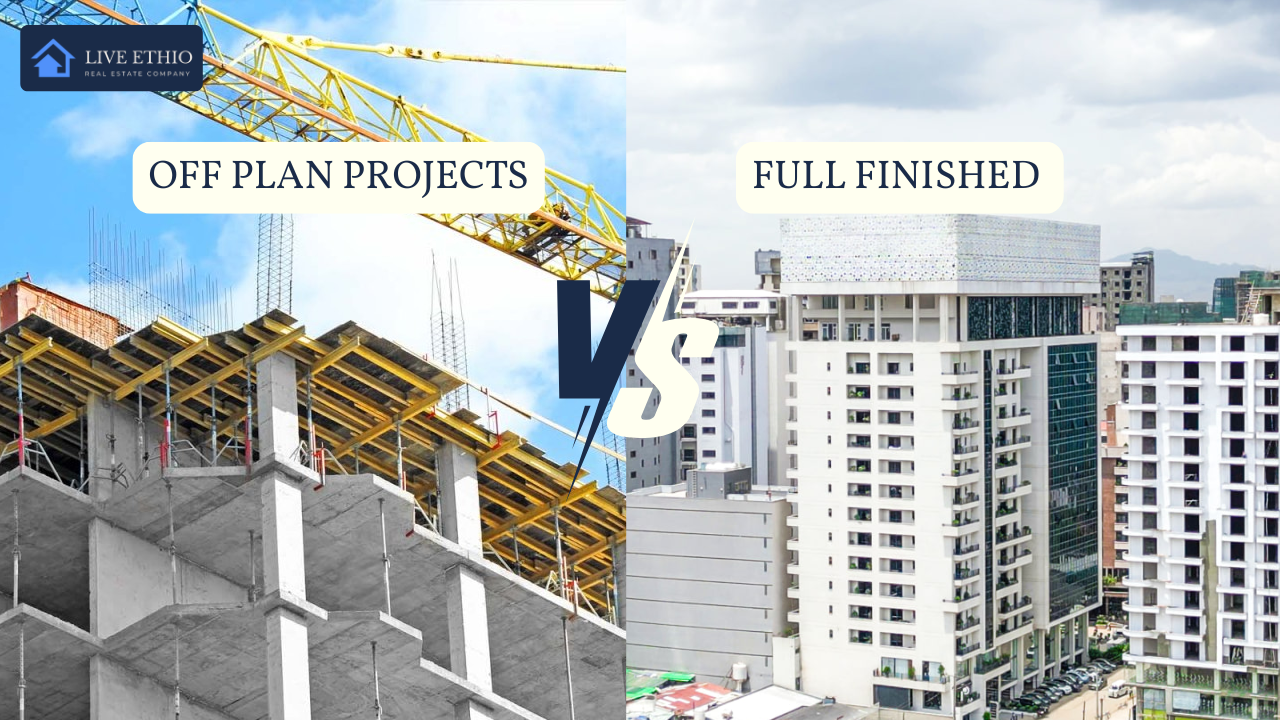
When investing in real estate in Addis Ababa, buyers often face a critical choice: should they purchase an off-plan property or a completed one? Both options come with unique advantages and risks, and understanding the differences can help investors and homeowners make informed decisions. Choosing the right approach is not only about price, but also about timing, risk tolerance, and long-term strategy.
Off-plan properties are units that are purchased before construction is completed, sometimes even before the project begins. The main advantage of buying off-plan is the potential for lower prices compared to completed units. Developers often offer discounts or flexible payment plans to early buyers as a way to secure funding for construction. Additionally, buyers can sometimes customize certain features such as finishes, layouts, or interior designs, allowing for a more personalized living space. Another benefit is that off-plan properties often promise significant capital appreciation by the time construction is finished, particularly in high-demand neighborhoods.
However, off-plan purchases come with inherent risks. Construction delays are common and can range from months to several years, affecting both move-in timelines and potential rental income. There is also the risk of developer default or incomplete projects, which can result in significant financial loss if legal protections are not in place. Market conditions may change during the construction period, potentially affecting the resale value or rental demand. For buyers seeking a deeper understanding of these risks, including real-world examples and practical precautions, we recommend checking out this detailed analysis from Living Ethio: Is Buying an Off-Plan Property a Risk in Addis Ababa? This blog complements the insights provided here and serves as a valuable resource for anyone considering an off-plan purchase.
On the other hand, completed properties offer immediate occupancy and rental potential. Buyers know exactly what they are paying for the unit’s location, quality, and condition are visible, leaving little ambiguity about the investment. Completed properties are particularly attractive for investors seeking stable rental income or homeowners who need to move in quickly. There is also a reduced risk of project failure, as the property exists and ownership transfer can happen without depending on construction timelines. These advantages make completed units ideal for more conservative buyers or those with limited tolerance for uncertainty.
Despite the benefits, completed properties may have higher upfront costs compared to off-plan units, particularly in prime locations. There is limited opportunity for customization, and the potential for capital appreciation is generally lower since the unit has already been built and priced at current market rates. Additionally, older properties may require maintenance, renovation, or upgrades to meet modern standards, which adds to the total investment cost.
Choosing between off-plan and completed properties ultimately depends on the buyer’s objectives, financial situation, and risk appetite. Off-plan properties are best suited for those willing to wait and take calculated risks for potentially higher returns. Completed properties appeal to buyers seeking certainty, immediate use, or stable rental income. Many investors adopt a balanced strategy, diversifying their portfolio by combining both property types to optimize risk and returns.
In conclusion, understanding the differences between off-plan and completed properties is essential for making intelligent real estate decisions in Addis Ababa. While off-plan units can offer discounts, customization, and future appreciation, they carry risks associated with construction delays and developer reliability. Completed properties provide certainty, immediate rental potential, and reduced risk but generally come with higher prices and limited customization. Buyers and investors who weigh these factors carefully are more likely to achieve long-term success in the city’s dynamic real estate market.