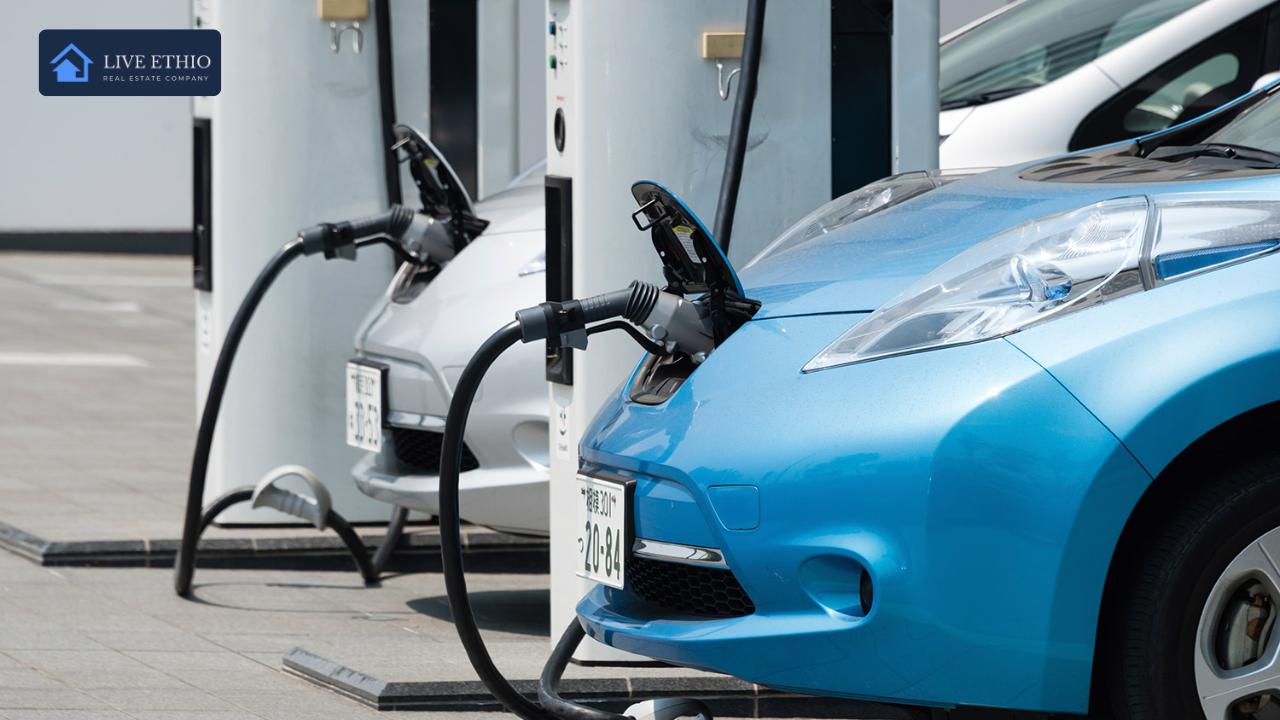
When people think about electric vehicles (EVs), they often imagine bustling cities like Los Angeles, London, or Beijing, where charging stations dot the streets and government incentives keep pushing drivers to make the switch. But look closer to home, and you’ll see that Addis Ababa is quietly preparing for the same transition. The Ethiopian government has waived import taxes on EVs, fuel prices remain unpredictable, and conversations about sustainability are gaining momentum. What feels like a global trend is starting to carve out its space in Ethiopia’s capital.
This shift goes beyond transportation it has the potential to reshape the real estate market in Addis Ababa, changing how homes are built, bought, and valued.
The Link Between EVs and Real Estate
Real estate has always been about location, infrastructure, and future potential. In Addis Ababa, infrastructure has traditionally meant roads, utilities, and access to basic services. With EVs entering the equation, we are adding another layer: charging accessibility.
Imagine two similar properties a house for sale in Addis Ababa in a prime area and another slightly farther from the city center. If the second house comes equipped with a home charging station or is near a reliable public charging point, it could become more attractive than the centrally located property without EV infrastructure. Suddenly, charging availability becomes a factor in buyer decision-making.
Demand for Modern Amenities
Buyers in Addis Ababa are already showing more interest in modern amenities spacious kitchens, secure compounds, and backup power. Soon, EV readiness will join that list. For developers, this means that installing charging points in new residential projects could be the difference between a fast sale and a lingering listing.
The same applies to apartments. For example, an apartment that comes with designated EV parking and shared charging facilities will stand out in a crowded market. Developers who act early and embrace this trend will appeal to forward-looking buyers, particularly the younger, tech-savvy generation and diaspora investors.
Broader Urban Impact
On a citywide level, EV adoption could encourage urban planners and policymakers to rethink neighborhood layouts. Areas with reliable power grids and space for public charging stations may rise in popularity, while neighborhoods struggling with electricity shortages may lose appeal. This could reshape price dynamics across Addis Ababa, pushing investment into areas that align with Ethiopia’s green future.
A Signal to Investors
For investors, EV adoption is more than a transportation issue it’s a market signal. Properties that are prepared for the future, whether through infrastructure or proximity to charging networks, will hold a premium. As Addis Ababa modernizes, the real estate sector will reward foresight.
As EV adoption grows, real estate in Addis Ababa will adapt to meet new buyer expectations. Charging infrastructure will become a selling point, sustainable building practices will gain more attention, and neighborhoods with easier access to EV-friendly amenities will rise in demand.
Whether you’re browsing for a house for sale in Addis Ababa or an apartment for sale in Addis Ababa, choosing a property that is future-ready will likely deliver stronger returns.
The shift is coming, and those who act early will be best positioned to benefit from it.